
Tag

Ancient Rome

Trastevere

By Monuments No Comments

Trastevere

Trastevere-gabbiaservices

Trastevere, is located on the right bank of the Tiber, south of the The Vatican City .

It includes the plain on the bend of the river and the Janiculum hill, (famous Roman hill, 88 meters high, from which it is possible to see the whole city.)

It is bordered to the south and west by the Gianicolense Walls and to the north by the Principe di Savoia-Aosta Gallery.

Origins

At the time of the founding of Rome, the Trastevere area was a hostile land that belonged to the Etruscans.

It was disputed with the newborn city because it was strategic for the control of the river and the ancient river port.

Trastevere was then connected with the rest of the city through the Ponte Sublicio, from which the Via Campana started, towards the salt pans on the Tyrrhenian Sea and later the Via Aurelia, towards the Etruscan cities.

In the Republican Age …

In the Republican age, it was populated by those workers whose activities were related to the river, such as sailors and fishermen, along with Eastern immigrants, mainly Jews and Syrians.

For this reason, some temples of oriental cults were built in the area, including the so-called Syriac Sanctuary on the Janiculum.

The consideration of the area as part of the city begins with the Emperor Augustus, who divided the territory of Rome into 14 regions.

The current Trastevere was the fourteenth and was called regio transtiberim.

However, the region remained outside the walls until the construction of the Aurelian Walls which incorporated Trastevere.

Thanks to the suburban character of the territory, in the imperial period many personalities decided to build their own villa in Trastevere, including that of Clodia, a friend of Catullus, and that of Julius Caesar.

In the Middle Ages…

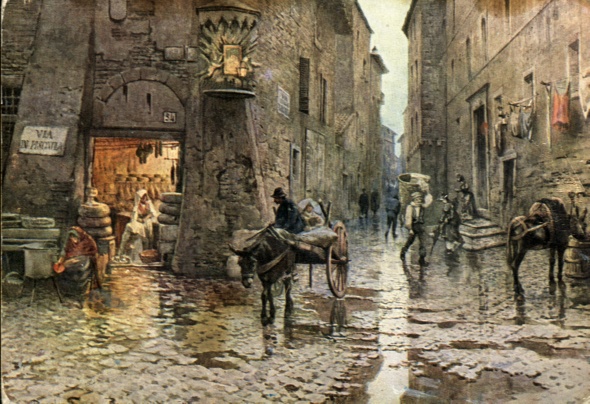
Trastevere in the Middle Ages had narrow, winding and irregular streets; moreover, due to the Mignani, projections protruding along the facades of the houses, there was not enough space for the passage of the wagons.

At the end of the fifteenth century these mignani were demolished, but despite this Trastevere remained a labyrinth of paths.

Strong was the contrast between the rich and mighty houses of the lords and the huts of the poorest people.

The streets did not have any type of paving until the end of the fifteenth century thanks to the intervention of Pope Sixtus IV.

The pope had some streets paved first with bricks of bricks placed in a herringbone pattern, then with cobblestones, more suitable for carriage wheels.
Trastevere-gabbiaservices

Later he divided Rome into fourteen districts.

Thanks to the partial isolation (since it was located beyond the Tiber) and the multicultural environment since the time of ancient Rome, the inhabitants of Trastevere, called Trastevere, came to form almost a separate population.

They were considered commoners of known tenacity, pride and genuineness.

Furthermore, women were considered very beautiful, with very dark eyes and hair and beautiful features.

After 1870, the walls were built to block the flooding of the Tiber.

This certainly brought greater security at the cost of destroying all the most characteristic places that were on the shore.

Trastevere-gabbiaservices

Today

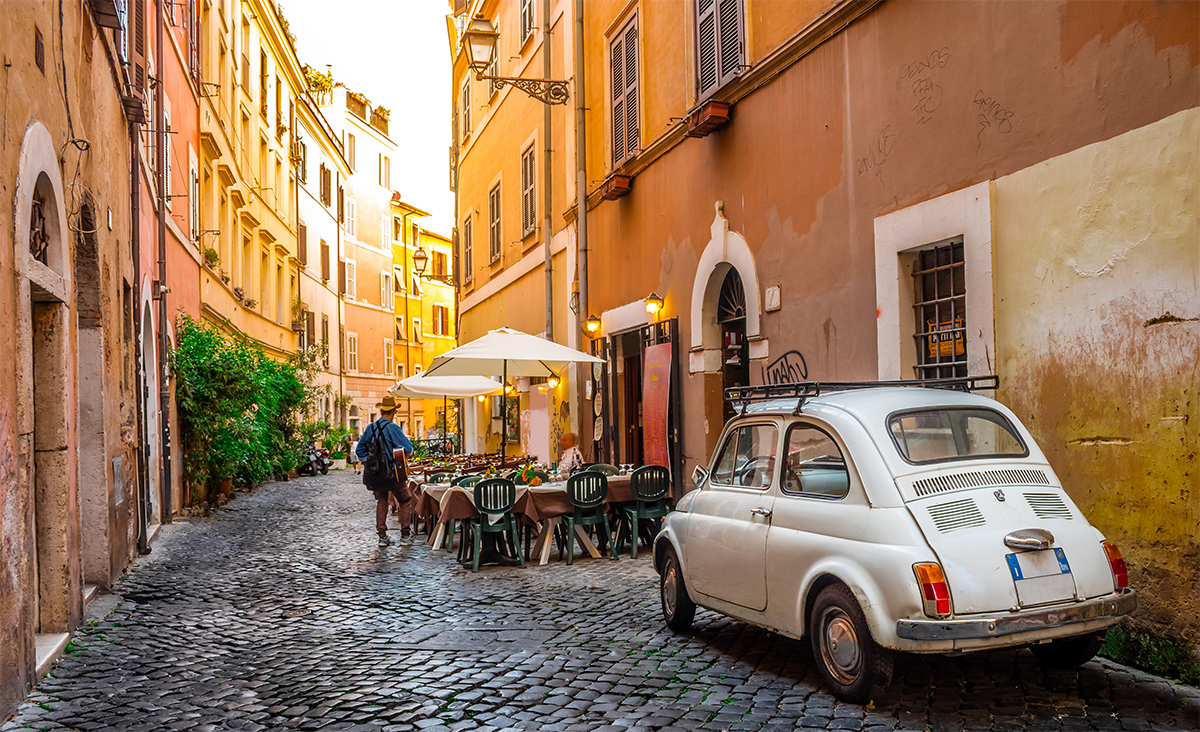
Today Trastevere still maintains its character thanks to the winding streets covered with cobblestones overlooked by medieval public houses.

The night is filled with people, both Italian and foreign, thanks to the wealth of typical Roman restaurants, clubs and pubs for every price range.

 Santa Maria in Trastevere Square

Trastevere-gabbiaservices

The basilica of Santa Maria in Trastevere (in the photo above on the left), which stands on the homonymous square, was probably the first official place of Christian worship built in Rome.

It is certainly the first dedicated to the cult of the Virgin.

Even today, walking through the streets of Trastevere it is possible to admire the characteristic tunnels and alleys of cobblestones that make tourists from all over the world lose their heads.

Gabbiaservices

Sant’Angelo Castle

By Monuments No Comments

Sant’Angelo Castle

Sant'Angelo Castle

Sant’Angelo Castle in Rome is perhaps one of the most representative and impressive monuments of the Eternal City.

Unmissable stop for those wishing to admire one of the most exciting views of the city and for photography enthusiasts.

The large fortress overlooking the Tiber indeed offers truly superlative views of Rome.

For this reason, if you are thinking of taking a tour in Rome, a stop at Castel Sant’Angelo certainly cannot be missing from your program.

Origin

It all began in 153 A.D. when the emperor Hadrian asked the architect Demetriano to build a funeral mausoleum for himself and his family, inspired by the model of the Mausoleum of Augustus, but with gigantic dimensions.

The works lasted several years and were completed by Antonino Pio in 139 .

This imposing monument is in fact known also as  The mausoleum of Augustus  but also Cagliostra Over the centuries, in fact, Castel Sant’Angelo has had many destinations, including that of prison.

From the name everyone would think it is a castle but it is not so.

In fact Castel Sant’Angelo was built to be the sepulcher of the emperor Hadrian and his descendants.

Features and Dimensions

The cubic base is covered with Lunese marble with decorative friezes with Bucrani.

The names of the emperors buried there were also written along this frieze,

and  the structure above the cube, on the other hand, is covered in travertine.

At the apex there was the sculpture of a bronze chariot headed by the emperor Hadrian.

It has a height of 48 meters.

Furthermore, Castel Sant ‘Angelo is connected to the Campo Marzio by means of the Elio bridge.

It is located between the Prati district and Borgo Pio.

Castel Sant’Angelo – Wikipedia

In the Middle Ages

During the Middle Ages, Castel Sant’Angelo was instead attributed a defensive function.

For this reason, the emperor Honorius included it in the Aurelian walls.

The appearance of the monument then turns into a fortress.

In fact, Caste Sant’Angelo still appears today as a mighty impregnable fortress.

Later, Theodoric turned it into a prison.

Here the inmates were kept in terrible conditions.

Obviously the richest inmates could have the privilege of being locked up in more luxurious prisons located in the upper part of the castle, called Cagliostra.

The property of Castel Sant ‘Angelo was disputed between many families and eventually ended up among the possessions of the Orsini family.

In 1200 Pope Nicholas III, belonging to the Orsini family, ceded it to the church during his pontificate.

It was he himself who wanted the construction of the Passetto di Borgo, or an underground tunnel that connects the castle to the Vatican.

In this way, in case of enemy attacks, the popes could escape to a safe place using a secret passage.

In fact, the passage was used on several occasions for this very purpose.

From the Renaissance to the present day

Starting from 1400, Castel Sant’Angelo began to be embellished.

Courtyards, arcades and papal apartments with luxurious decorations were added.

Today Castel Sant’Angelo houses a permanent national museum and temporary exhibitions.

It preserves numerous rather heterogeneous collections, merged in different historical moments.

Visiting the castle, it is possible to walk along the mighty ramparts overlooking the river and admire a poignant, truly breathtaking, 360 ° view over the city.

Why Sant’Angelo Castle?

Famous is the terrace of the Angel so called because a colossal statue of the Archangel Michael was placed there.

The statue refers to the plague that occurred in the period of Gregory the Great.

The saint decided to make a procession to the castle and there he had the vision of the angel in the act of sheathing his sword.

This vision ended the epidemic.

From this anecdote, here is the current name of “Sant’Angelo Castle”.


Gabbiaservices

The Colosseum

By Monuments No Comments

The Colosseum

The Colosseum

The Colosseum, originally called the Flavian Amphitheater, stands in the archaeological heart of the city of Rome.

Origins

The amphitheater was built in the Flavian period on an area on the eastern edge of the Roman Forum.

Its construction was started by Vespasian in 70 AD. and inaugurated by Tito in 80, with further changes made during Domitian’s empire in 90.

The building, known as the Colosseum because of a colossal statue that stood nearby, until the end of the ancient age, shows of great popular appeal, such as hunts and gladiator games.

The building was, and still remains today, a spectacle in itself.

It is in fact the largest amphitheater in the world, able to offer surprising scenographic equipment, as well as services for the spectators.

Able to hold an estimated number of spectators between 50,000 and 87,000.

It is the most important Roman amphitheater, as well as the most imposing monument of ancient Rome that has come down to us.

Symbol of the glories of the empire, the Amphitheater has changed its face and function over the centuries, offering itself as a structured space but open to the Roman community.

Colosseo – Wikipedia

Dimensions

Building forms an ellipse of 527 m in perimeter, with axes measuring 187.5 and 156.5 m.

The arena inside measures 86 × 54 m, with an area of ​​3 357 m².

Current height reaches 48.5 m, but originally it reached 52 m.

Decline

In 438 with the abolition of gladiator games at the behest of Valentinian III the amphitheater undergoes a slow and progressive decline so much so that it was used in the Middle Ages and the Renaissance as a quarry for materials,

also used for the construction of St. Peter’s Basilica,

and as shelter for animals and home for craft workshops and homes,

while the process of its Christianization is long.

From the romantic period in which the charm of the ruin attracted writers and artists,

it soon passed to that of systematic excavations and restorations.

Today

Today the Amphitheater is a monument to the works of human ingenuity that survive the time and still presents itself as a welcoming and dynamic structure that offers a wide overview of the interior spaces, but also evocative views of the city when you look out from the external archways.

It periodically hosts temporary exhibitions related to the themes of antiquity and its relationship with the contemporary, as well as modern shows.

This result of events and experiences has made the Amphitheater a place that is renewed every day, meaningful for everyone and capable of telling everyone a story.

Rome is not just a city, but an open-air history book …

Navona Square

By Squares No Comments

Navona Square

Piazza Navona. Il più Celebre Capolavoro del Barocco a Roma

Navona Square is one of the most famous monumental squares in Rome.

Origins

In ancient times, it was born as, the “Domitian Stadium” built at the behest of Domitian, perhaps even before 86 AD, to serve the Greek athletic games, which he particularly appreciated, but which the Romans did not like, considering them immoral.

Dimensions

The structure has a length of 265 meters and a width of 106.

Birth of Navona Square

The life of Navona Square began only in the mid-fifteenth century, at the behest of Innocenzo X, of the Pamphili family, who had the buildings that now surround the square built, occupying where the tiers were previously.

It took the place of the ancient Domitian Stadium, becoming a fixed point of sale for vegetables, meats and various goods.

Place of market and meeting, the square also became the place of parties and processions.

Navona Square is a symbol of Baroque Rome, with architectural and sculptural elements by Gian Lorenzo Bernini.

Piazza Navona – RomaSegreta.it

The Fountains

Famous work of Benini is the Fountain of the Four Rivers in the center of the square, which represents the Danube, the Ganges, the Nile and the Rio della Plata, that is the four corners of the earth.

Two other fountains rise inside the square, Moro Fontain, located on the southern side which represents three dolphins holding up a snail, from which a jet of water splashes,

and Nettuno Fontain , which represents Neptune with the trident. defending itself from an octopus.

Navona Square today.

Today the square is surrounded by clubs, bars and restaurants, where you can sip a coffee while admiring the wonders of the square.

It is located a stone’s throw from the beautiful Campo dè Fiori Square, still famous today where the local market takes place every morning.

Also nearby is the majestic Farnese Square, site of the French embassy.

Behind the square stands the imposing monument of the Pantheon.

During the Christmas period, with the feast of the Epiphany, the square is filled with stalls, toys, as if not wanting to abandon the joy that has characterized the square for centuries.

Gabbiaservices

  • Italiano


Privacy Policy Cookie Policy